Showing posts with label Chitral. Show all posts

Friday, October 7, 2011

Kelash experience

Centuries old Kelash culture is at a greater risk today than any time in the past. Despite their remote location - landlocked in winters - last of the Kelash race is maintaining tenacious hold in district Chitral but is vulnerable to ravages of time and different pressures with external locus.

The onslaughts are clearly eating at their open and nonchalant culture. Many have been forced to join the drift to the cities. But when asked what they want, their collective answer was simple: we want our old way of life. Which is why, pastoral Kelash have been able to keep some of their cultural traditions and identity so far.Some historians and anthropologists think that the Kelash are descendants of Indo-Aryans who overran the region in the second millennium BC. The Kelash say they are from a place called Tsiam, though nobody is sure where that is. Commonly they are considered as descendants of Alexander from Macedon who came this way. Their warrior like forebears managed for centuries to keep everyone - including Tamerlane - at bay. In 1893, the British and Afghan governments agreed on a common border that cut right through Kafiristan dividing the community into two parts. Abdur Rahman who was then Amir of Afghanistan renamed Afghan Kafiristan as Nuristan - land of Light.


The Kelash are called Kafirs (infidels) and their land is known as Kafiristan. Between the 13th and 16th centuries the Chitralis gradually subdued the Kelash. By the 19th century, Kelash had been pushed into the higher valleys of the southern Hindu Kush. Rudyard Kipling set his book “The Man who would Be King” in Kafiristan, portraying the people as fierce and credulous though he never went there. And later, what Geoffrey Moorhouse has described in his book "To the Frontier" is no more there. Even the Chitral town of days when Russian were in Afghanistan (shops used to be full of the US goods like sleeping bags, shoes and field jackets) is no more there.

Not properly documented in our history books, I had the opportunity to explore the Kelash valleys in the widespread and on the edge district Chitral in Pakistan and know the people during my two years long in small village Mirkhanni – a gateway to Kalash trilogy. There are no villages called Rumbor, Bumbret or Birir. These are the valleys inhabited by Kelashis. One can take a 4 x 4 jeep (or hire one) from Attaliq Bazaar Chitral, or more adventurous type can get off on foot and walk along river Kunar up to Ayun.

From Ayun, the road forks left to Bumbret and right to Rumbor. After the fork, the barely jeep able roads to Rumbor and Bumbret - steady climb - will give you a new appreciation for walking particularly if you have been missing walking. There you will see lush green tree lined terraces, dancing and noisy torrents and lofty snow capped peaks set at a distance in the backdrop of forests of Himalayan. Rumbor is friendliest of all valleys where as Bumbret is most picturesque. The mouth of Birir Valley is at village Gahiret, about seven kilometres south of Ayun. Birir - the traditional of all valleys - peters out beyond village Guru. Near the village, you will find out a breathtakingly beautiful spring beneath a mound of stones. It is possible to trek between the valleys. There are also some good locations for 'rock repelling' and places for camping especially in Birir.

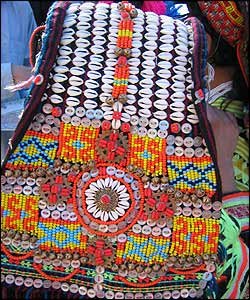
Lively by nature, the Kelash are a bit Mediterranean looking, though they gamut from fair and nearly blonde to quite whitish. Men have largely traded traditional goat skin tunics for Shalwar Qamiz and Chirtali caps, often with plumes, feathers, or fresh flowers in the brim. It is the dress of the women that is unique and quite amazing. Even in the fields, women wear immense black or brown dresses reaching to the ground, bound at the waist with a sash. Over locks of hair they wear splendid headpieces decorated with cowries, shells, beads, buttons, coins and plumes. The formal forms of these outfits are spectacular, with embroidery, mounds of bead necklaces and bells. They often decorate their faces with mulberry juice tattoos or pomegranate seeds or blacken them with burnt goat's horn (also for sunburn protection). I once saw a three years old child completely coated with the soot of burnt horns. A local told, "This will keep the baby fair coloured through out life."

The Kelash religion is complex and polytheistic with a single creator, called Dezau or Khodai, and many other lesser gods and spirits, each with its own responsibilities. Two important ones are the warrior gods Mahandeo, guardian of crops, animals, other public matters, and the female goddess Jestak who cares for home, family and private matters. All need occasional compensations, usually in the form of goat sacrifices and ceremonies at their shrines scattered through the valleys. The religious traditions are taught by one generation to the next.

Traditionally the dead are not buried. The wooden coffins used to be placed on the ground. Wooden totes or effigies were carved for wealthy or honoured people. At few old style graveyards I saw, the coffins fallen open, wood pieces and bones scattered about. Totems are scarce now; some carted off by anthropologists and treasure hunters. "Swat and Karachi museums have a few in good conditions," informed a German researcher Laila Mason, whom I met in village Bashala. These days the dead are simply placed on cart in the graveyard.

Tradition has it that women are less pure than men are and there are precise rules about what each may do, where they may go and how to purify people and places. Women during menstruation or childbirth are confined to a lodge called Bashaleni (which is also a shrine to the goddess Dezalik, who looks after births). Men cannot go in; even other women must be 'purified' after a visit. In old days, even food could be served to the women confined in Bashaleni only by virgin boys, untouched by women. Gradually these traditions are losing their power. But still it is the women that are seen working around in fields or homes and men spend all their quality time sitting on the pathways. The burden of perpetuating the last strains of Kelash culture is also born by women alone.

The Kelash take their festivals seriously. In addition to religious ceremonies there is always dancing and local made wine. Typically the older men stand in the centre, taking turns chanting old legends. Accompanied by drums the women dance round them arms around one another's waists and shoulders in spinning twos and threes or trance like encircling lines.

There may be day dancing (adua-naat) and night dancing (raadt-naat) or both. Some may even be closed to outsiders. Each valley has its own style and timing. The dates may not be fixed until the last minute, often depending on harvest or other work, so you could end up waiting days or even weeks for the kick off. Locals from down country may find it difficult to attend any such function but foreigners are often welcome. A Swedish tourist Toni has an interesting theory for this. He says, "Kelash people do not like those who go looking for alcohol, hashish, women or pure salageet.

This feast dedicated to spring and to future harvests is called Joshi. It includes day dancing and family reunions for four to six days in mid May. The summer festival Uchau, celebrating the wheat and barley harvests, is a big tourist draw. It may include night dancing every few days in successive villages, form mid June to mid August. Pul is held only in Birir, for three or four days in late September or early October. Night dancing is held in various villages and day dancing on the last day. It marks the walnut and grape harvests and the end of wine making, though its origins concern the return of shepherds from the high pastures. This solstice festival called Chaumos is probably the biggest for the Kelash, with visiting, feasting and night dancing for around 10 days starting in mid December.

"It is in unique culture that Kelash differ from the rest of the country," confirms Pordum, an elderly resident of village Guru. It is also perhaps the sole claim to fame for the region besides gorgeous natural beauty, poverty and backwardness. Laila Mason says, "unless opportunities are created and due respect is given, this unique culture will disappear fast."

Friday, February 25, 2011

The embroidery effect

Social enterprises use market-based models and strategies for a social purpose by working with skilled craftsmen, artisans, farmers and so on at the grassroots level. Currently in Pakistan, there are a handful of organisations that can be correctly labeled as a social enterprise and Polly & Me is one of them. Founded in 2003 by two sisters, Cath and Ange Braid, Polly & Me has introduced the handicraft and traditional embroidery skills of Chitrali women to the international market.


Cath, who has studied art and design from London, first visited Chitral in December 2000 to work on her final year’s thesis. It was then she came to know and fall in love with Pakistan. Along with her sister Ange, she founded Polly & Me in 2007. After living in Chitral for a few years, Cath is now settled in Islamabad and makes regular trips to check on the progress of the womens embroidery collective.


Dawn.com speaks to Cath Braid, the force behind the initiative, on some of the challenges she has faced and even some things she learnt along the way. – Text by Amna Khalique and Photography by Eefa Khalid/Dawn.com, [Polly and Me]

Sunday, October 10, 2010

Living at their own in Chitral

Some places are so peaceful and unspoiled that it is almost unbelievable. One such locality is the picturesque, tranquil and pollution free (and undeveloped) boarder village Arrandu in district Chitral. The very sound of the name is musical. This village is located 'on' the Pakistan Afghanistan boarder. Dir-Chitral Road bifurcates near village Mir Khanni and a jeep able track along Kunar River leads to Arrandu through Domail Nisar and onwards into Afghanistan.

Gateway to the South Asia, the Chitral valley has been center of activity since ancient times. Macedonians advanced through this region in fourth century. In 1338, Timur subdued the area on his way to the plains of Punjab. Mughal King Akbar garrisoned here in 1587 and the British in 1897 in Chakdara on Dir side of Lowari Pass. Among soldiers who served here in Chakdara then was young Winston Churchill who later became Prime Minister of Britain. So far about the past importance of the valley but the little hamlet got the international fame during Soviet occupation in Afghanistan. It remained in the news and was commonly called as 'BBC Baby'.

Arrandu is set up on the bank of Kunar River flowing into Afghanistan. Terraced fields of wheat, barley, maize and fragrant orchards of walnuts, apricots, grapes, apples and mulberries are strung up the valley like flags, at the feet of bare or thinly forested mountain walls.

The 3118-meter Lowari Pass is normally open to vehicles from June to October. One can sometime cross the pass on foot in May or November, despite the snow. One can also reach this small hamlet from Peshawar to Chitral by air and then by road to Arrandu or from Afghanistan. Though taking flight to Chitral is not everyone's cup of tea because the Fokker Friendship can cross the Lowari Pass only if weather permits. It rarely does particularly once the valley is landlocked in winters. First time, I landed in Chitral after three attempts by Fokker. Flying above the clouds, I had a window seat on the West Side of the small and noisy aircraft and could see the sighs of Hindu Kush where clouds allowed. Chitral to Arrandu via Drosh along Kunar River is easily one of the prettiest drives in the valley.

Chitral Scouts have kept this post in a very good shape. And, when ever I happened to pass the post conducting 'travelers' from down country or alone, I was always given a warm welcome and send off by Essa Khan, a local who has the biggest store cum tea house in the village. He also has arrangements for Trout fishing in Kunar River near his store. After zig zagging on a difficult road, one can spend a good day at the riverbank fishing and relaxing, with supply of tea from the Pinion Shah's teashop. And, to me Pinion Shah used to present, every time I visited him, a gift of pure salageet (Shilajit) - an oozing black paste from rocks famous among men in this part of the world as an anti aging and sexual health. After Afghan refugees and occasional travelers, now this road is used by herd of goats lead by a lonely Gujars to and from greener pastures. That is the place, which I use as a retreat from the hustle and bustle of urban life and that is where "I go to reminisce about fairies."

While the entire Chitral Valley is breathtaking in its splendor and beauty, one of my most enduring memories of Arrandu is watching the sunrise over the hills. And, when you devote enough time to look at the mountains, it becomes a bit chameleon - clouding over, changing colors, cliffs turning into convex and concave according to the slant light.

Arrandu has red roofed grand mosque and some makeshift provision stores that are stocked in summers when Lowari Pass is open to road traffic. There is also a water mill for grinding grain. Lot of tracks interlaces the area that is frequented by Mazdas or pedestrians.

At night, lights glow in this isolated village. One finds men spending their quality time sitting on the retaining walls along the razor edged roads and tracks while women (mostly with enlarged thyroid glands due to lack of iodine) working in the fields, homes or collecting woods from hills in conical wicker baskets. Even in their fifties men carry guns along with a belt of ammunition. The fact is that I found them friendly and at peace with themselves.

There are side valleys that yawn on both sides of Kunar River for hiking in its upper reaches. Friendly people of Tajik origin who had came from Badakhshan in Afghanistan only a few generations ago, to manufacture matchlock rifles for the Mehtar of Chitral populate the area. Arrandu Road is an ideal place to study the effects of land erosion: how it ruins the land and clogs waterways. And, there are some beautiful geological formations along the road. Besides scenery, there are many well-used camping grounds on both sides of the road and river, which run side by side.

Isolated from the rest of the country because of the remote location, Chitralis live a primitive rural existence without any civic amenities. Even the TV transmissions, telephone and electricity only in some parts of distract are a recent phenomenon. "Why would anyone want to live in a country like that?" Pinion Shah smiled and said, "I guess we like it here because we like to be left alone. Oh, it is nice to have people visiting. And we like people all right. But we like them on our own terms." And, he was right. I could hear him, murmuring sitting on his old stool: a freedom that meets other people only on its own terms - and yet forces you to care about every one of your neighbors scattered across the hillocks. Most of the Chitralis whom I asked confessed, "We like and want our own way of life." That is what is keeping them there.

Wednesday, May 5, 2010

Around Arrandu

Some places are so peaceful and unspoiled that it is almost unbelievable. One such locality is the picturesque, tranquil and pollution free (and undeveloped) boarder village Arrandu in district Chitral. The very sound of the name is musical. This village is located 'on' the Pakistan Afghanistan boarder. Dir-Chitral Road bifurcates near village Mir Khanni and a jeep able track along Kunar River leads to Arrandu through Domail Nisar and onwards into Afghanistan.

Gateway to the South Asia, the Chitral valley has been center of activity since ancient times. Macedonians advanced through this region in fourth century. In 1338, Timur subdued the area on his way to the plains of Punjab. Mughal King Akbar garrisoned here in 1587 and the British in 1897 in Chakdara on Dir side of Lowari Pass. Among soldiers who served here in Chakdara then was young Winston Churchill who later became Prime Minister of Britain. So far about the past importance of the valley but the little hamlet got the international fame during Soviet occupation in Afghanistan. It remained in the news and was commonly called as 'BBC Baby'.
Arrandu is set up on the bank of Kunar River flowing into Afghanistan. Terraced fields of wheat, barley, maize and fragrant orchards of walnuts, apricots, grapes, apples and mulberries are strung up the valley like flags, at the feet of bare or thinly forested mountain walls.

The 3118-meter Lowari Pass is normally open to vehicles from June to October. One can sometime cross the pass on foot in May or November, despite the snow. One can also reach this small hamlet from Peshawar to Chitral by air and then by road to Arrandu or from Afghanistan. Though taking flight to Chitral is not everyone's cup of tea because the Fokker Friendship can cross the Lowari Pass only if weather permits. It rarely does particularly once the valley is landlocked in winters. First time, I landed in Chitral after three attempts by Fokker. Flying above the clouds, I had a window seat on the West Side of the small and noisy aircraft and could see the sighs of Hindu Kush where clouds allowed. Chitral to Arrandu via Drosh along Kunar River is easily one of the prettiest drives in the valley.

Chitral Scouts have kept this post in a very good shape. And, when ever I happened to pass the post conducting 'travelers' from down country or alone, I was always given a warm welcome and send off by Essa Khan, a local who has the biggest store cum tea house in the village. He also has arrangements for Trout fishing in Kunar River near his store. After zig zagging on a difficult road, one can spend a good day at the riverbank fishing and relaxing, with supply of tea from the Pinion Shah's teashop. And, to me Pinion Shah used to present, every time I visited him, a gift of pure salageet (Shilajit) - an oozing black paste from rocks famous among men in this part of the world as an anti aging and sexual health. After Afghan refugees and occasional travelers, now this road is used by herd of goats lead by a lonely Gujars to and from greener pastures. That is the place, which I use as a retreat from the hustle and bustle of urban life and that is where "I go to reminisce about fairies."

While the entire Chitral Valley is breathtaking in its splendor and beauty, one of my most enduring memories of Arrandu is watching the sunrise over the hills. And, when you devote enough time to look at the mountains, it becomes a bit chameleon - clouding over, changing colors, cliffs turning into convex and concave according to the slant light.

Arrandu has red roofed grand mosque and some makeshift provision stores that are stocked in summers when Lowari Pass is open to road traffic. There is also a water mill for grinding grain. Lot of tracks interlaces the area that is frequented by Mazdas or pedestrians.

At night, lights glow in this isolated village. One finds men spending their quality time sitting on the retaining walls along the razor edged roads and tracks while women (mostly with enlarged thyroid glands due to lack of iodine) working in the fields, homes or collecting woods from hills in conical wicker baskets. Even in their fifties men carry guns along with a belt of ammunition. The fact is that I found them friendly and at peace with themselves.

There are side valleys that yawn on both sides of Kunar River for hiking in its upper reaches. Friendly people of Tajik origin who had came from Badakhshan in Afghanistan only a few generations ago, to manufacture matchlock rifles for the Mehtar of Chitral populate the area. Arrandu Road is an ideal place to study the effects of land erosion: how it ruins the land and clogs waterways. And, there are some beautiful geological formations along the road. Besides scenery, there are many well-used camping grounds on both sides of the road and river, which run side by side.

Isolated from the rest of the country because of the remote location, Chitralis live a primitive rural existence without any civic amenities. Even the TV transmissions, telephone and electricity only in some parts of distract are a recent phenomenon. "Why would anyone want to live in a country like that?" Pinion Shah smiled and said, "I guess we like it here because we like to be left alone. Oh, it is nice to have people visiting. And we like people all right. But we like them on our own terms." And, he was right. I could hear him, murmuring sitting on his old stool: a freedom that meets other people only on its own terms - and yet forces you to care about every one of your neighbors scattered across the hillocks. Most of the Chitralis whom I asked confessed, "We like and want our own way of life." That is what is keeping them there.

Tags: ,